Choosing between ChatGPT vs Claude vs Gemini in 2026 is the single most important AI decision you’ll make this year. These three AI assistants have evolved dramatically, each carving out distinct strengths that make them indispensable for different workflows. Whether you’re a developer debugging complex code, a writer crafting compelling content, or a business professional analyzing data, the right choice could save you hours every week — and the wrong one could cost you.
After extensive testing and research across coding, writing, analysis, and creative tasks, here’s the quick verdict: ChatGPT is the best all-rounder with the most mature ecosystem. Claude produces the highest-quality writing and excels at long-document analysis. Gemini offers the best value and deepest Google integration. But the full picture is far more nuanced — read on for the complete breakdown that will help you choose (or combine) the right AI tools for your specific needs.
This comprehensive guide from AI Tools Hub covers everything: benchmarks, pricing, features, privacy policies, and real-world performance across every major use case.
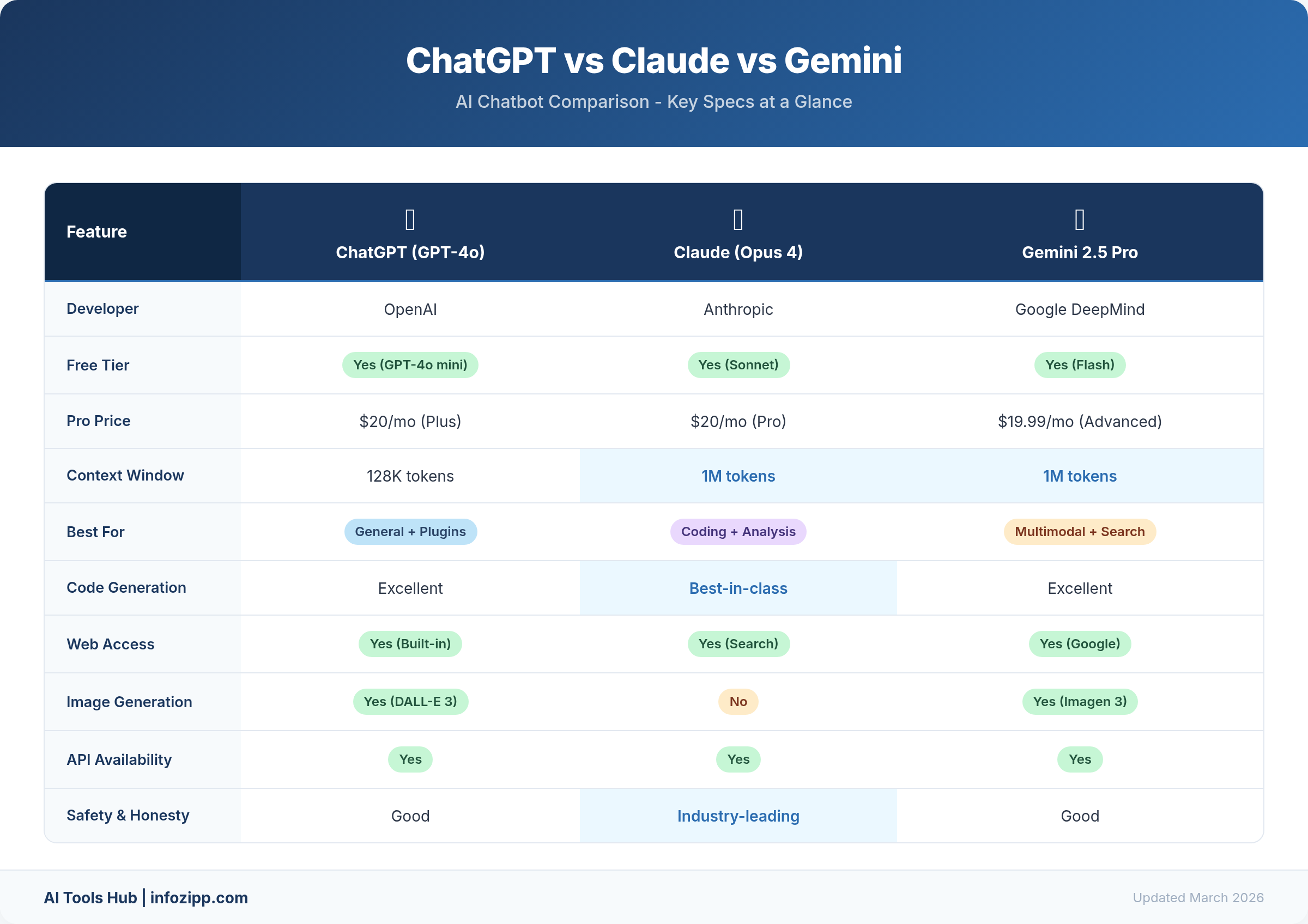
Quick Comparison Table: ChatGPT vs Claude vs Gemini at a Glance
Before diving deep, here’s a side-by-side snapshot of where each AI assistant stands in March 2026:
| Feature | ChatGPT (GPT-5.4) | Claude (Opus 4.6) | Gemini (2.5 Pro / 3.1) |
|---|---|---|---|
| Developer | OpenAI | Anthropic | Google DeepMind |
| Latest Model | GPT-5.4 (Mar 2026) | Opus 4.6 (Feb 2026) | Gemini 3.1 Pro (Feb 2026) |
| Context Window | 256K tokens | 1M tokens | 2M tokens |
| Free Tier | Yes (limited GPT-5.2) | Yes (daily caps) | Yes (Gemini Flash) |
| Paid Plan (Individual) | $20/mo (Plus) | $20/mo (Pro) | $19.99/mo (AI Pro) |
| Premium Tier | $200/mo (Pro) | $100–$200/mo (Max) | $249.99/mo (AI Ultra) |
| Image Generation | Native (GPT-4o) | No (SVG/artifacts only) | Native (Imagen) |
| Video Understanding | Limited (frames) | No | Native (up to 3 hours) |
| Output Speed | ~110 tokens/sec | ~80 tokens/sec | ~130 tokens/sec |
| Best For | All-round productivity | Writing, coding, analysis | Google ecosystem, multimedia |
ChatGPT (GPT-5 / o-Series): The Versatile Powerhouse
OpenAI’s ChatGPT remains the most widely used AI assistant in the world, and for good reason. With the launch of GPT-5.4 in March 2026, ChatGPT has cemented its position as the most versatile AI tool available. It does nearly everything well, from writing and coding to image generation and research.
ChatGPT’s Key Strengths
- Most mature ecosystem: ChatGPT has the largest plugin library, the most third-party integrations, and the most reliable multi-step tool sequences of any AI assistant. The GPTs store offers thousands of custom AI agents for specialized tasks.
- Native image generation: GPT-4o’s built-in image generation has replaced DALL-E 3 and dramatically improved quality. It achieves 87% photorealism convincingness (vs. DALL-E 3’s 62%) and renders text within images near-perfectly — a breakthrough that eliminated the “AI-generated look” problem.
- Strong coding capabilities: GPT-5.4 excels at test generation, producing comprehensive test suites with meaningful edge case coverage. It scores 80.0% on SWE-bench Verified.
- Best marketing copy: For brand voice adaptation and sales-oriented writing, ChatGPT produces the most precise commercial content.
- Advanced Voice Mode: Real-time voice conversations with natural intonation and the ability to handle interruptions make ChatGPT feel like talking to a knowledgeable colleague.
ChatGPT’s Weaknesses
- Smaller context window: At 256K tokens, GPT-5.4 has the smallest context window of the big three. For very large documents or codebases, you’ll need chunking strategies or RAG pipelines.
- Tendency toward verbosity: ChatGPT often over-explains and adds unnecessary caveats, which can be frustrating when you need concise answers.
- Privacy concerns: By default, ChatGPT uses your conversations to train future models. You can opt out, but the default-on approach raises concerns for sensitive work.
ChatGPT Pricing Tiers (2026)
| Plan | Price | Key Features |
|---|---|---|
| Free | $0 | Limited GPT-5.2 access, basic image generation, standard voice mode |
| Go | $8/mo | GPT-5.2 Instant, image generation, file uploads |
| Plus | $20/mo | GPT-5.2 Thinking mode, 5x usage limits, Advanced Voice, DALL-E 4 |
| Pro | $200/mo | Unlimited GPT-5.2 Pro, maximum reasoning compute, largest context windows |
| Team | $25–$30/user/mo | Admin controls, shared workspace, data not used for training |
Best Use Cases for ChatGPT
ChatGPT is ideal for users who need a single AI tool that handles everything reasonably well. It’s particularly strong for marketing copy, quick code generation, image creation, and anyone who wants the broadest possible integration ecosystem with third-party apps and plugins.
Claude (Opus 4.6 / Sonnet): The Writer’s and Coder’s AI
Anthropic’s Claude has quietly become the favorite AI assistant among professional writers, developers, and researchers. Claude Opus 4.6, released in February 2026, pushed the boundaries with a 1 million token context window with 95%+ recall — meaning it can analyze entire books, full codebases, or hundreds of pages of legal documents in a single conversation without losing track of details.
Claude’s Key Strengths
- Superior writing quality: Claude consistently produces the most natural, human-like prose among all AI assistants. It avoids AI cliches, creates compelling headlines with specific numbers and problem identification, and maintains a natural rhythm that other models lack. For content creation, blog writing, and creative work, Claude is the clear leader.
- Best long-document analysis: With its 1M token context and 95%+ recall, Claude can catch contradictions between page 12 and page 487 — something competitors consistently miss. This makes it invaluable for legal review, academic research, and codebase analysis.
- Top-tier coding: Claude Opus 4.6 leads on SWE-bench Verified with an 80.8% score. It excels at debugging and refactoring, leveraging its massive context window for holistic understanding of large codebases. Claude Code, the terminal-based coding agent, enables autonomous programming and repository management.
- Strongest privacy posture: Claude does not use your chat data to train its models. Conversations can be deleted and are purged within 30 days. It holds SOC 2 Type II and ISO 42001 certifications, making it the most privacy-conscious choice.
- Best instruction following: Claude consistently ranks highest for following complex, multi-step instructions precisely — a critical advantage for professional workflows.
Claude’s Weaknesses
- No native image generation: Unlike ChatGPT and Gemini, Claude cannot generate photos or illustrations. It can create SVG graphics and interactive charts through Artifacts, but for image generation you’ll need external tools.
- Slower output speed: At approximately 80 tokens per second, Claude is noticeably slower than Gemini (130 t/s) and ChatGPT (110 t/s). For rapid-fire tasks, this adds up.
- Smaller integration ecosystem: Claude has fewer third-party plugins and integrations compared to ChatGPT’s extensive marketplace, though its MCP (Model Context Protocol) ecosystem is growing rapidly.
- No video understanding: Claude cannot process video content natively, putting it behind Gemini for multimedia workflows.
Claude Pricing Tiers (2026)
| Plan | Price | Key Features |
|---|---|---|
| Free | $0 | Daily usage caps, access to Sonnet, basic features |
| Pro | $20/mo | Priority access, higher usage limits, Opus 4.6 access, Projects feature |
| Max 5x | $100/mo | 5x Pro usage, Claude Code access, priority during peak times |
| Max 20x | $200/mo | 20x Pro usage, virtually unlimited for full-day development work |
| Team | $25–$30/user/mo | Shared workspace, admin controls, higher limits |
Best Use Cases for Claude
Claude is the best choice for professional writing, long-document analysis, complex coding projects, and anyone who prioritizes privacy and data security. If you’re a writer, researcher, lawyer, or developer working with large codebases, Claude should be your primary tool.
Gemini (2.5 Pro / 3.1 Series): The Google-Powered Contender
Google’s Gemini has matured into a formidable competitor, and with the Gemini 3.1 Pro release in February 2026, it’s no longer the underdog. Gemini’s greatest advantages are its deep Google ecosystem integration, massive context window, and — crucially — its aggressive pricing that undercuts both rivals.
Gemini’s Key Strengths
- Largest context window: Gemini 2.5 Pro offers a 2 million token context window — the largest of any major AI model. While effective recall drops off around 1.2M tokens, this is still enormous and sufficient for processing entire codebases or book-length documents.
- Best multimodal capabilities: Gemini was built from the ground up as a multimodal system. It natively processes images, video (up to 3 hours), audio, PDFs, and code repositories. No other AI assistant matches this breadth of input types.
- Fastest output speed: At approximately 130 tokens per second, Gemini is the fastest of the three — roughly 60% faster than Claude for rapid prototyping and quick-turnaround tasks.
- Deep Google integration: For teams already in the Google ecosystem, Gemini integrates seamlessly with Gmail, Google Docs, Sheets, Slides, and Drive. The Deep Research feature generates multi-page reports by autonomously browsing and synthesizing web sources.
- Most affordable API pricing: Gemini 2.5 Pro costs just $1.50/M input tokens and $7.00/M output tokens — significantly cheaper than Claude ($4.00/$20.00) and ChatGPT ($3.00/$12.00).
- Native image generation: Through Imagen integration, Gemini can generate and edit images directly within conversations.
Gemini’s Weaknesses
- Writing quality lags behind: While competent, Gemini’s creative writing and content generation lacks the distinctive voice and natural prose quality that Claude achieves. For professional content creation, it falls noticeably short.
- Recall degrades at extreme lengths: Despite the 2M token window, Gemini’s accuracy drops significantly beyond 1.2M tokens, meaning you can’t fully rely on it for the longest documents.
- Privacy concerns: By default, Gemini conversations may be reviewed by humans to improve product quality. Google’s broader data collection practices also raise concerns for privacy-conscious users.
- Less consistent for complex reasoning: On nuanced, multi-step reasoning tasks, Gemini occasionally produces less reliable results compared to Claude and ChatGPT.
Gemini Pricing Tiers (2026)
| Plan | Price | Key Features |
|---|---|---|
| Free | $0 | Gemini Flash access, basic features, limited daily usage |
| Google AI Pro | $19.99/mo | Gemini 3 Pro, Deep Research, 2TB cloud storage, Workspace AI integration |
| Google AI Ultra | $249.99/mo | Gemini 2.5 Deep Think, Veo 3.1 video, 25K monthly AI credits, 30TB storage, YouTube Premium |
| Google Workspace | Custom pricing | Enterprise security, admin controls, data governance, audit logs |
Best Use Cases for Gemini
Gemini shines for users deeply embedded in the Google ecosystem, teams working with multimedia content (especially video), and organizations that need cost-effective API access at scale. It’s also the best choice for real-time research thanks to its Google Search grounding feature.
Head-to-Head Comparisons
Now let’s compare these three AI assistants across the categories that matter most for everyday use.
Writing Quality
| Criteria | ChatGPT | Claude | Gemini |
|---|---|---|---|
| Natural prose | Good | Excellent | Adequate |
| Marketing copy | Excellent | Good | Adequate |
| Blog/article writing | Good | Excellent | Good |
| Avoids AI cliches | Average | Excellent | Average |
| Instruction following | Good | Excellent | Good |
Winner: Claude. For writing quality, Claude stands apart. It produces the most natural, engaging prose and consistently avoids the robotic patterns that make AI-generated text instantly recognizable. ChatGPT is better for sales-oriented copy, while Gemini is competent but less distinctive.
Coding Ability
| Criteria | ChatGPT | Claude | Gemini |
|---|---|---|---|
| SWE-bench Verified | 80.0% | 80.8% | 80.6% |
| Debugging | Good | Excellent | Good |
| Test generation | Excellent | Good | Good |
| Rapid prototyping | Good | Good | Excellent |
| Large codebase understanding | Limited (256K) | Excellent (1M) | Good (2M, recall drops) |
| Coding agent tools | Codex (built-in) | Claude Code (terminal) | Gemini Code Assist |
Winner: Claude (slightly). The SWE-bench scores are remarkably close — within 1 point of each other. Claude edges ahead thanks to its superior debugging capabilities and large context window that enables holistic codebase understanding. ChatGPT leads in test generation, while Gemini’s speed makes it best for rapid prototyping. In practice, many developers use all three for different coding tasks.
Research and Analysis
Winner: Claude for document analysis; Gemini for web research. Claude’s 1M token context with 95%+ recall makes it unbeatable for analyzing large documents, contracts, or research papers — it catches contradictions and subtle details that others miss. However, Gemini’s Google Search grounding and Deep Research feature make it superior for live web research and synthesizing information from multiple online sources. ChatGPT offers a solid middle ground with good analysis capabilities and web browsing.
Image Generation and Understanding
| Capability | ChatGPT | Claude | Gemini |
|---|---|---|---|
| Image generation | Excellent (native) | None (SVG only) | Good (Imagen) |
| Image analysis | Good | Good (Vision) | Excellent |
| Text in images | Near-perfect | N/A | Good |
| Video understanding | Limited | No | Excellent (3hr) |
| Photorealism | 87% convincing | N/A | Good |
Winner: ChatGPT for image generation; Gemini for multimedia understanding. ChatGPT’s native GPT-4o image generation is a game-changer — photorealistic results with accurate text rendering. Gemini wins for understanding existing visual content, especially video. Claude’s lack of image generation is its most significant gap, though its image analysis through Vision is solid.
Context Window and Long Documents
Winner: Claude. While Gemini technically has the largest context window at 2M tokens, Claude’s 1M token context with 95%+ recall rate is more practically useful. Gemini’s recall degrades significantly beyond 1.2M tokens, meaning Claude actually outperforms it on documents between 256K and 1.2M tokens. ChatGPT’s 256K limit requires workarounds for very large documents but is sufficient for most everyday tasks.
Privacy and Safety
| Factor | ChatGPT | Claude | Gemini |
|---|---|---|---|
| Data used for training | Yes (opt-out available) | No | Yes (human review possible) |
| Security certifications | Basic | SOC 2 Type II, ISO 42001 | Google Cloud security |
| Data retention | Persistent (deletable) | 30-day purge | Up to 18 months |
| Enterprise data isolation | Yes (Business/Enterprise) | Yes (all paid tiers) | Yes (Workspace Enterprise) |
Winner: Claude. Anthropic takes privacy the most seriously. Claude doesn’t use your data for training by default, holds rigorous security certifications, and purges deleted conversations within 30 days. For anyone handling sensitive business data, legal documents, or personal information, Claude is the safest choice.
API and Developer Experience
| Factor | ChatGPT / OpenAI | Claude / Anthropic | Gemini / Google |
|---|---|---|---|
| Input cost (per 1M tokens) | $3.00 | $4.00 | $1.50 |
| Output cost (per 1M tokens) | $12.00 | $20.00 | $7.00 |
| Batch API pricing | $1.50 / $6.00 | $2.00 / $10.00 | $0.75 / $3.50 |
| Ecosystem maturity | Most mature | Growing (MCP) | Google Cloud native |
| Free API tier | Limited | Limited | Generous |
Winner: Gemini for cost; ChatGPT for ecosystem. Gemini is dramatically cheaper at the API level — roughly 50-65% less expensive than competitors. For startups and indie developers building AI-powered applications, this cost advantage is massive. However, OpenAI’s API ecosystem remains the most mature with the best documentation, most SDKs, and largest community of developers.
Complete Pricing Comparison: Free vs Paid Tiers
Here’s the full breakdown of what you get at each price point across all three platforms:
| Price Point | ChatGPT | Claude | Gemini |
|---|---|---|---|
| Free ($0) | Limited GPT-5.2, basic image gen, voice mode | Sonnet access, daily caps, basic features | Gemini Flash, basic features, daily limits |
| ~$8/mo | Go: GPT-5.2 Instant, uploads | — | — |
| ~$20/mo | Plus: GPT-5.2 Thinking, 5x limits | Pro: Opus 4.6, priority access, Projects | AI Pro: Gemini 3 Pro, Deep Research, 2TB storage |
| ~$100/mo | — | Max 5x: 5x Pro usage, Claude Code | — |
| ~$200/mo | Pro: Unlimited GPT-5.2 Pro, max reasoning | Max 20x: 20x Pro usage, unlimited for most work | — |
| ~$250/mo | — | — | AI Ultra: Top models, Veo 3.1, 25K AI credits, 30TB, YouTube Premium |
| Team | $25–30/user/mo | $25–30/user/mo | Custom (Workspace) |
Best value at $20/month: All three are competitively priced at the individual level. Gemini edges ahead slightly by including 2TB of Google cloud storage. Claude offers the best model access at this tier (Opus 4.6). ChatGPT provides the most features (image gen, voice, plugins).
Which AI Assistant Should You Choose? Decision Matrix
The “best” AI assistant depends entirely on your primary use case. Here’s a clear recommendation for every type of user:
For Students and Academics
Best choice: Claude — Superior writing quality helps with essays and papers without sounding robotic. The massive context window is perfect for analyzing research papers and textbooks. Strong instruction following means more accurate answers to complex academic questions. Start with the free tier and upgrade to Pro ($20/mo) during exam periods.
For Software Developers
Best choice: Claude — Highest SWE-bench score, best debugging capabilities, and the 1M token context window means it can understand your entire codebase at once. Claude Code provides autonomous terminal-based coding. However, keep ChatGPT as a secondary tool for test generation, and use Gemini when you need rapid prototyping or cost-effective API access.
For Business Professionals
Best choice: ChatGPT — The most versatile option with the broadest plugin ecosystem. Strong at email drafting, presentations, data analysis, and general business writing. The Go plan at $8/month offers excellent value for moderate users. If your company runs on Google Workspace, Gemini becomes the better choice for its seamless integration.
For Content Writers and Marketers
Best choice: Claude for writing; ChatGPT for visuals. Use Claude for drafting blog posts, articles, and any content where natural prose matters. Switch to ChatGPT when you need image generation for social media, blog featured images, or marketing materials. Gemini can supplement with rapid research via Deep Research.
For Data Analysts and Researchers
Best choice: Gemini for web research; Claude for document analysis. Gemini’s Deep Research feature and Google Search grounding make it unbeatable for synthesizing information from the web. Claude’s context window and recall accuracy make it superior for analyzing large datasets, reports, and documents you upload directly.
For Creative Professionals (Design, Video, Art)
Best choice: Gemini — Native video understanding (up to 3 hours), image generation via Imagen, and the upcoming Veo 3.1 video generation (on Ultra plan) make Gemini the most capable multimodal creative tool. ChatGPT’s image generation is excellent for still images, but Gemini’s broader multimedia capabilities give it the edge for creative workflows.
For Privacy-Conscious Users
Best choice: Claude — No contest. Claude doesn’t train on your data, holds the strongest security certifications, and offers the most transparent data handling policies. If you’re working with sensitive client data, legal documents, medical records, or financial information, Claude is the only responsible choice among the three.
For Budget-Conscious Users
Best choice: Gemini — The most generous free tier, cheapest paid plan ($19.99/mo with 2TB storage included), and lowest API pricing make Gemini the best choice when cost is a primary concern. The free tier alone is quite capable for light to moderate daily use.
The Verdict: Our Recommendations for 2026
After thorough testing and analysis, here’s our final recommendation:
If you can only pick one: ChatGPT Plus ($20/mo) remains the safest single choice. It does everything well — writing, coding, image generation, research, and voice interaction — and has the largest ecosystem of plugins and integrations. You won’t be disappointed in any category, even if it’s not the absolute best in each one.
If you’re a professional writer or developer: Claude Pro ($20/mo) is worth every penny. The writing quality and coding capabilities are noticeably superior for serious work, and the privacy benefits give you peace of mind with sensitive projects.
If you live in Google’s ecosystem: Google AI Pro ($19.99/mo) integrates so deeply with Gmail, Docs, and Drive that it feels like a natural extension of your workflow. The included 2TB of storage sweetens the deal.
The power user approach: Many professionals now subscribe to two services — typically Claude + ChatGPT or Claude + Gemini — using each for its strengths. At $40/month total, this combination gives you best-in-class writing and coding (Claude) plus image generation and broad versatility (ChatGPT) or cost-effective research (Gemini).
The AI landscape in 2026 is not a winner-take-all race. Each of these three platforms has genuine, defensible advantages. The smartest approach is to understand what you need most and choose accordingly — or combine them strategically for the best of all worlds.
Frequently Asked Questions
Is ChatGPT still the best AI in 2026?
ChatGPT remains the most versatile and widely-used AI assistant, but it’s no longer the best at everything. Claude surpasses it in writing quality and coding benchmarks, while Gemini beats it in multimodal capabilities and pricing. ChatGPT’s strength is that it does everything well and has the largest ecosystem.
Is Claude better than ChatGPT for coding?
Yes, slightly. Claude Opus 4.6 scores 80.8% on SWE-bench Verified compared to ChatGPT’s 80.0%. More importantly, Claude’s 1M token context window allows it to understand entire codebases at once, making it superior for debugging and refactoring large projects. ChatGPT is better for quick code generation and test writing.
Is Gemini free to use?
Yes, Gemini offers a free tier with access to Gemini Flash and basic features with daily usage limits. For access to the more powerful Gemini 3 Pro model and features like Deep Research, you’ll need Google AI Pro at $19.99/month.
Which AI is cheapest for API access?
Gemini is significantly cheaper for API access. Gemini 2.5 Pro costs $1.50/M input tokens and $7.00/M output tokens, compared to ChatGPT’s $3.00/$12.00 and Claude’s $4.00/$20.00. For batch processing, Gemini’s pricing drops even further to $0.75/$3.50 per million tokens.
Which AI is safest for sensitive data?
Claude is the safest choice for sensitive data. It doesn’t use your conversations for training, holds SOC 2 Type II and ISO 42001 certifications, and purges deleted data within 30 days. Both ChatGPT and Gemini use conversation data for training by default (though both offer opt-out options).
Can I use all three AI assistants together?
Absolutely, and many professionals do exactly this. A common approach is using Claude for writing and coding, ChatGPT for image generation and general tasks, and Gemini for research and Google Workspace integration. At $60/month for all three paid tiers, this gives you best-in-class capabilities across every category.
Which AI has the largest context window?
Gemini technically has the largest at 2 million tokens, but Claude’s 1 million token context with 95%+ recall accuracy is more practically useful. Gemini’s recall degrades significantly beyond 1.2 million tokens, while Claude maintains high accuracy across its entire window.
Will ChatGPT, Claude, or Gemini replace the others?
Unlikely in 2026. Each platform is backed by a major tech company (OpenAI/Microsoft, Anthropic/Amazon, Google) with billions in funding. The competition is actually driving rapid innovation that benefits users. Expect all three to continue improving and differentiating rather than converging.
For the latest AI assistant comparisons and in-depth reviews, stay updated with AI Tools Hub — we test every tool so you can choose the right AI for your needs.
{ “@context”: “https://schema.org”, “@type”: “FAQPage”, “mainEntity”: [ { “@type”: “Question”, “name”: “Is ChatGPT still the best AI in 2026?”, “acceptedAnswer”: { “@type”: “Answer”, “text”: “ChatGPT remains the most versatile and widely-used AI assistant, but it’s no longer the best at everything. Claude surpasses it in writing quality and coding benchmarks, while Gemini beats it in multimodal capabilities and pricing. ChatGPT’s strength is that it does everything well and has the largest ecosystem.” } }, { “@type”: “Question”, “name”: “Is Claude better than ChatGPT for coding?”, “acceptedAnswer”: { “@type”: “Answer”, “text”: “Yes, slightly. Claude Opus 4.6 scores 80.8% on SWE-bench Verified compared to ChatGPT’s 80.0%. More importantly, Claude’s 1M token context window allows it to understand entire codebases at once, making it superior for debugging and refactoring large projects. ChatGPT is better for quick code generation and test writing.” } }, { “@type”: “Question”, “name”: “Is Gemini free to use?”, “acceptedAnswer”: { “@type”: “Answer”, “text”: “Yes, Gemini offers a free tier with access to Gemini Flash and basic features with daily usage limits. For access to the more powerful Gemini 3 Pro model and features like Deep Research, you’ll need Google AI Pro at $19.99/month.” } }, { “@type”: “Question”, “name”: “Which AI is cheapest for API access?”, “acceptedAnswer”: { “@type”: “Answer”, “text”: “Gemini is significantly cheaper for API access. Gemini 2.5 Pro costs $1.50/M input tokens and $7.00/M output tokens, compared to ChatGPT’s $3.00/$12.00 and Claude’s $4.00/$20.00. For batch processing, Gemini’s pricing drops even further to $0.75/$3.50 per million tokens.” } }, { “@type”: “Question”, “name”: “Which AI is safest for sensitive data?”, “acceptedAnswer”: { “@type”: “Answer”, “text”: “Claude is the safest choice for sensitive data. It doesn’t use your conversations for training, holds SOC 2 Type II and ISO 42001 certifications, and purges deleted data within 30 days. Both ChatGPT and Gemini use conversation data for training by default (though both offer opt-out options).” } }, { “@type”: “Question”, “name”: “Can I use all three AI assistants together?”, “acceptedAnswer”: { “@type”: “Answer”, “text”: “Absolutely, and many professionals do exactly this. A common approach is using Claude for writing and coding, ChatGPT for image generation and general tasks, and Gemini for research and Google Workspace integration. At $60/month for all three paid tiers, this gives you best-in-class capabilities across every category.” } }, { “@type”: “Question”, “name”: “Which AI has the largest context window?”, “acceptedAnswer”: { “@type”: “Answer”, “text”: “Gemini technically has the largest at 2 million tokens, but Claude’s 1 million token context with 95%+ recall accuracy is more practically useful. Gemini’s recall degrades significantly beyond 1.2 million tokens, while Claude maintains high accuracy across its entire window.” } }, { “@type”: “Question”, “name”: “Will ChatGPT, Claude, or Gemini replace the others?”, “acceptedAnswer”: { “@type”: “Answer”, “text”: “Unlikely in 2026. Each platform is backed by a major tech company (OpenAI/Microsoft, Anthropic/Amazon, Google) with billions in funding. The competition is actually driving rapid innovation that benefits users. Expect all three to continue improving and differentiating rather than converging.” } } ] }Explore More on AI Tools Hub

Alex Kim is an AI tools reviewer and tech writer with over 5 years of experience evaluating SaaS and AI products. He specializes in hands-on comparisons of AI writing assistants, coding tools, and productivity software — testing each tool through real-world workflows before publishing any recommendation. His mission at AI Tools Hub is to help readers cut through the hype and find AI tools that actually deliver results.