Artificial intelligence is no longer an optional upgrade for marketing teams — it is the foundation of every competitive strategy. In 2026, businesses that lack a clear AI marketing strategy guide 2026 are already falling behind. From hyper-personalized email sequences to ad campaigns that optimize themselves in real time, AI has moved from experimental to essential across every marketing channel. The question is no longer whether you should use AI in your marketing. The question is how fast you can build a system that connects the right AI tools to the right workflows.
This guide gives you a complete, actionable framework for creating an AI marketing strategy that covers content, paid advertising, email, social media, analytics, and SEO. Whether you run a lean startup or manage marketing at a mid-size company, you will walk away with a clear roadmap, specific tool recommendations, and implementation steps you can start using this week.
Why You Need an AI Marketing Strategy in 2026
Marketing without AI in 2026 is like marketing without the internet was in 2010 — technically possible but practically self-defeating. Here is what has changed:
- Consumer expectations have shifted. Buyers expect personalized experiences at every touchpoint. AI is the only way to deliver that personalization at scale without ballooning your team size.
- Data volume has exploded. The average business now generates more behavioral data in a week than it used to generate in a year. Manual analysis cannot keep up. AI-powered analytics tools process this data in minutes.
- Competitors are already using AI. According to recent industry surveys, over 80% of marketing teams now use at least one AI tool. The leaders are using five or more, connected into a unified stack.
- Cost efficiency demands it. AI marketing tools routinely deliver 2–5x returns on investment by reducing manual labor, improving targeting precision, and accelerating content production cycles.
A proper AI marketing strategy is not about throwing tools at problems. It is about building a connected system where AI handles repetitive execution while humans focus on creative direction and strategic decisions.
Content Marketing AI: Produce More, Rank Higher
Content remains the backbone of organic growth. AI has transformed every stage of the content pipeline, from ideation to distribution.
Key Tools for AI Content Marketing
- Jasper — Enterprise-grade content generation with brand voice training and campaign workflows. Best for teams producing high volumes of marketing copy across channels.
- Copy.ai — Workflow-first platform that connects content generation to GTM pipelines. Strong for B2B teams that need sales enablement content alongside blog posts.
- Writesonic — Budget-friendly option with built-in SEO scoring, article generation, and a factual engine that pulls from live web data. Ideal for small teams and solopreneurs.
- SurferSEO — AI-powered content optimization that analyzes top-ranking pages and provides real-time scoring to help your articles compete in search results.
- Frase — Research-first content tool that generates content briefs, outlines, and drafts based on SERP analysis.
If you are deciding between the top writing platforms, our detailed Jasper vs Copy.ai vs Writesonic comparison breaks down pricing, features, and ideal use cases for each tool.
Implementation Strategy for AI Content
- Audit your current content workflow. Map every step from topic research through publishing. Identify where the bottlenecks live — usually research, first drafts, and optimization.
- Deploy AI at bottleneck points first. Use AI writing assistants for first drafts and AI SEO tools for optimization. Keep human editors for final quality control and brand voice alignment.
- Build a content brief template. Feed AI tools structured briefs that include target keyword, search intent, audience segment, desired tone, and required sections. Better inputs produce dramatically better outputs.
- Establish a human review layer. AI-generated content should always pass through a human editor who adds original insights, verifies facts, and ensures the piece matches your brand perspective.
For a deeper walkthrough on combining AI tools with SEO best practices, check out our guide on how to write SEO blog posts with AI.
Paid Advertising AI: Smarter Spend, Better Returns
AI has fundamentally changed how paid advertising works. The platforms themselves — Google Ads, Meta Ads, LinkedIn — now run on AI. Your job is to feed them better data and layer additional AI tools on top.
Key Tools for AI-Powered Advertising
- Google Performance Max — Google’s fully AI-driven campaign type that optimizes across Search, Display, YouTube, Gmail, and Discover simultaneously.
- Meta Advantage+ — Meta’s AI campaign suite that automates audience targeting, creative selection, and placement optimization across Facebook and Instagram.
- AdCreative.ai — Generates high-converting ad creatives and copy variations using performance data. Eliminates the creative bottleneck that slows down testing cycles.
- Revealbot — AI-powered ad automation that manages bid adjustments, budget allocation, and campaign scaling rules across multiple platforms.
- Pencil — Uses generative AI to produce video ad variations and predicts which versions will perform best before you spend a dollar.
Implementation Strategy for AI Ads
- Feed first-party data into platform AI. Upload customer lists, implement conversion tracking across your full funnel, and use enhanced conversions. The more signal you give the AI, the better it performs.
- Use AI creative tools to increase testing velocity. Instead of testing 3 ad variations per month, use AdCreative.ai or Pencil to test 30. Let the platform AI find winners faster.
- Automate budget rules. Set up automated rules through Revealbot or native platform tools to shift budget toward high-performing campaigns and pause underperformers without manual intervention.
- Layer AI analytics on top. Use tools like Triple Whale or Northbeam to get AI-powered attribution modeling that goes beyond last-click and shows you the true ROI of each channel.
Email Marketing AI: Personalization That Converts
Email remains one of the highest-ROI marketing channels, and AI has made it significantly more powerful by enabling true one-to-one personalization at scale.
Key Tools for AI Email Marketing
- Klaviyo — The leading email and SMS platform for e-commerce, with AI-powered predictive analytics, send-time optimization, and dynamic content blocks.
- ActiveCampaign — Combines email automation with CRM and uses AI to score leads, predict churn, and optimize send times.
- Mailchimp (Intuit) — Now features AI-generated subject lines, content suggestions, and predictive segmentation that makes it more powerful than ever for small businesses.
- Seventh Sense — AI send-time optimization that integrates with HubSpot and Marketo. Delivers emails to each individual subscriber at the time they are most likely to open.
- Phrasee — AI-powered copywriting specifically for email subject lines, preheaders, and body copy. Uses performance data to continuously improve language that drives opens and clicks.
Implementation Strategy for AI Email
- Segment your list using AI. Move beyond basic demographic segments. Use AI-powered behavioral segmentation to group subscribers by purchase patterns, engagement levels, and predicted lifetime value.
- Automate send-time optimization. Stop guessing when to send. Tools like Seventh Sense and Klaviyo analyze individual subscriber behavior to deliver emails at the optimal moment.
- Use AI for subject line testing. Instead of manual A/B tests with two subject lines, use Phrasee or built-in AI tools to generate and test dozens of variations automatically.
- Build AI-driven triggered sequences. Set up behavior-triggered email flows — abandoned cart, post-purchase, re-engagement — and let AI optimize the content, timing, and frequency of each message.
Social Media AI: Scale Your Presence Without Scaling Your Team
Managing social media across multiple platforms is one of the most time-consuming tasks in marketing. AI tools now handle scheduling, content creation, community management, and performance analysis.
Key Tools for AI Social Media
- Hootsuite (OwlyWriter AI) — AI content generation built into one of the most established social management platforms. Generates post variations, suggests optimal posting times, and provides AI-powered analytics.
- Sprout Social — Enterprise social management with AI-powered listening, sentiment analysis, and automated reporting that identifies trends before they peak.
- Buffer AI Assistant — Generates post ideas, repurposes content across formats, and suggests hashtags. Integrates smoothly with a clean scheduling interface.
- Lately.ai — Takes long-form content like blog posts, webinars, and podcasts and uses AI to atomize them into dozens of social media posts optimized for each platform.
- Brandwatch — AI-powered social listening and consumer intelligence platform that monitors brand mentions, tracks competitors, and identifies emerging conversations in your industry.
Implementation Strategy for AI Social Media
- Centralize your social workflow. Choose one management platform (Hootsuite, Sprout Social, or Buffer) as your command center. Connect all accounts and establish approval workflows.
- Repurpose content automatically. Use Lately.ai to turn every blog post into 20+ social posts. Use AI video tools to create short clips from longer content. Maximize the value of every piece of content you produce.
- Deploy AI listening for real-time response. Set up Brandwatch or Sprout Social to monitor brand mentions, competitor activity, and industry keywords. Use AI-powered alerts to catch opportunities and crises early.
- Let AI handle community management basics. Use AI-powered auto-responses for common questions and route complex conversations to human team members. This keeps response times low without overwhelming your team.
Analytics and Reporting AI: Make Data-Driven Decisions Faster
The biggest bottleneck in most marketing operations is not data collection — it is data interpretation. AI analytics tools solve this by surfacing insights, predicting trends, and generating reports automatically.
Key Tools for AI Marketing Analytics
- Google Analytics 4 (GA4) — Now features AI-powered insights, predictive audiences, and anomaly detection built directly into the free platform.
- Mixpanel — Product and marketing analytics with AI-generated insights that automatically surface significant changes in user behavior.
- Triple Whale — AI-powered attribution for e-commerce that combines pixel data, post-purchase surveys, and machine learning to show true marketing ROI across channels.
- Improvado — Marketing data aggregation platform that uses AI to normalize data from 500+ sources and generate automated insights.
- Narrative BI — Generative AI analytics that automatically creates narrative reports from your marketing data. Ask questions in plain English and get data-backed answers.
Implementation Strategy for AI Analytics
- Consolidate your data sources. Use a platform like Improvado or a custom data warehouse to bring all marketing data into one place. AI analytics tools are only as good as the data they can access.
- Set up AI-powered anomaly detection. Configure GA4 or Mixpanel to alert you automatically when metrics deviate significantly from expected patterns. Catch problems before they become expensive.
- Replace manual reporting with AI. Use Narrative BI or built-in AI reporting features to generate weekly and monthly performance reports automatically. Free your team from spreadsheet work.
- Build predictive models. Use GA4 predictive audiences and Triple Whale’s AI attribution to forecast which campaigns will drive the most value and allocate budget accordingly.
SEO AI: Dominate Search Results With Intelligent Optimization
Search engine optimization has become an AI-augmented discipline. From keyword research to technical audits to content optimization, AI tools accelerate every aspect of SEO.
Key Tools for AI-Powered SEO
- SurferSEO — Real-time content scoring and optimization recommendations based on analysis of top-ranking pages for any target keyword.
- Semrush Copilot — AI assistant built into Semrush that monitors your site, identifies issues, and suggests prioritized actions to improve rankings.
- Clearscope — AI content optimization that provides topic-level scoring and ensures your content covers the semantic depth that search engines expect.
- Screaming Frog + ChatGPT Integration — Combine technical crawling with AI analysis to identify and prioritize technical SEO issues at scale.
- MarketMuse — AI-powered content planning that identifies content gaps, suggests topics, and creates detailed briefs based on competitive analysis.
Implementation Strategy for AI SEO
- Run an AI-assisted site audit. Use Screaming Frog and Semrush Copilot to identify technical issues, broken links, thin content, and crawl problems. Let AI prioritize fixes by impact.
- Use AI for keyword clustering. Instead of targeting individual keywords, use MarketMuse or Semrush to build topic clusters that establish topical authority and capture long-tail traffic.
- Optimize existing content with AI. Run your top 50 pages through SurferSEO or Clearscope. AI will identify missing subtopics, semantic gaps, and optimization opportunities that can boost rankings without creating new content.
- Monitor and adapt with AI insights. Set up automated rank tracking and let AI tools alert you to ranking changes, algorithm updates, and competitive shifts that require action.
Step-by-Step Framework: Building Your AI Marketing Stack
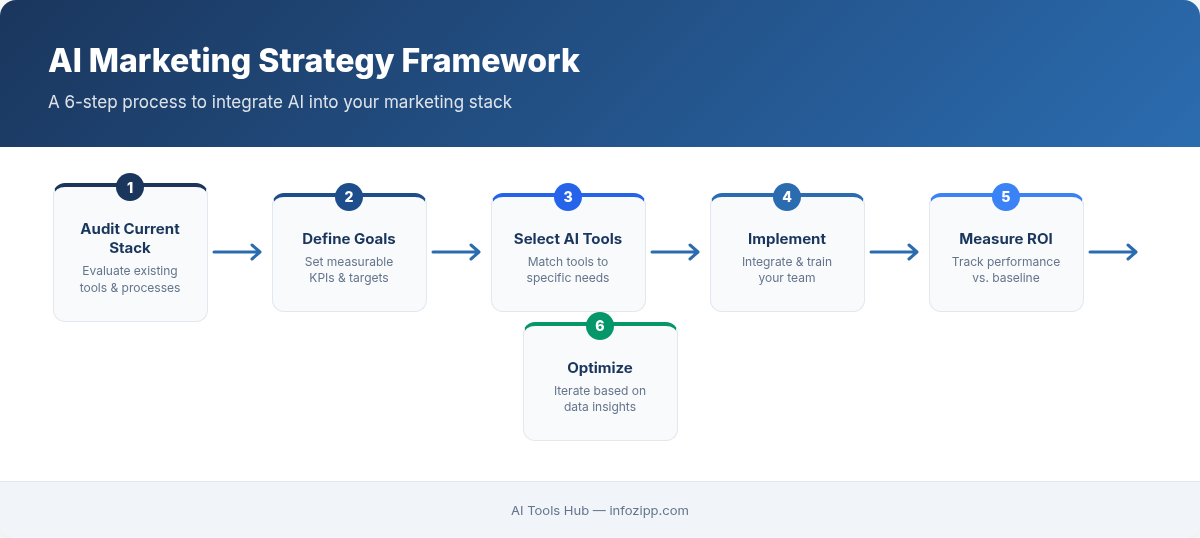
Now that you understand the AI tools available for each marketing channel, here is a practical framework for building your complete AI marketing stack. Follow these steps in order.
Step 1: Audit Your Current Marketing Operations
Before adding any AI tools, map your existing marketing processes. Document every workflow across content, ads, email, social, and analytics. Rate each on a scale of 1–5 for how manual, time-consuming, and error-prone it is. The highest-scoring workflows are your priority targets for AI.
Step 2: Define Your AI Marketing Goals
Set specific, measurable goals for your AI marketing strategy. Examples:
- Reduce content production time by 50% while maintaining quality
- Improve ad ROAS by 30% through AI-powered optimization
- Increase email open rates by 20% using AI send-time optimization
- Cut reporting time from 8 hours per week to 1 hour
Step 3: Select Your Core Platform Stack
Choose one primary AI tool for each channel based on your budget and team size. Here is a recommended starter stack:
- Content: Jasper or Writesonic + SurferSEO
- Ads: Platform-native AI (Google Performance Max, Meta Advantage+) + AdCreative.ai
- Email: Klaviyo or ActiveCampaign
- Social: Hootsuite or Buffer + Lately.ai
- Analytics: GA4 + Narrative BI or Triple Whale
- SEO: Semrush Copilot + SurferSEO
Step 4: Integrate and Connect Your Tools
AI tools deliver maximum value when they share data. Connect your stack using native integrations or platforms like Zapier and Make:
- Connect your CRM to your email platform for AI-powered segmentation
- Feed ad platform conversion data back to your analytics tools
- Link your content calendar to your social media management platform
- Set up automated data flows from all channels to your analytics dashboard
Step 5: Establish Human-AI Workflows
Define clear roles for AI and humans in every workflow:
- AI handles: First drafts, data analysis, scheduling, A/B test management, bid optimization, routine reporting
- Humans handle: Strategy, brand voice, creative direction, relationship building, final approval, ethical oversight
The most effective AI marketing teams use a “human-in-the-loop” model where AI does 80% of the execution work and humans provide 20% of high-value strategic direction.
Step 6: Measure, Learn, and Iterate
Set up monthly reviews of your AI marketing performance:
- Track time saved per workflow compared to pre-AI baselines
- Measure quality metrics (engagement rates, conversion rates, customer satisfaction) to ensure AI is not sacrificing quality for speed
- Evaluate new AI tools quarterly. The landscape evolves rapidly, and better options may emerge
- Document what works and share learnings across your team
Common Mistakes to Avoid With AI Marketing
Even the best AI marketing strategy can fail if you fall into these traps:
- Tool overload. Do not subscribe to 20 AI tools at once. Start with 3–5 core tools, master them, then expand. Every new tool adds complexity and cost.
- Ignoring data quality. AI is only as good as the data it trains on. Dirty CRM data, broken tracking pixels, and inconsistent naming conventions will sabotage even the best AI tools.
- Removing humans entirely. AI-generated content without human review often lacks nuance, contains errors, or sounds generic. Always keep humans in the loop for quality and brand consistency.
- Chasing features over outcomes. Evaluate AI tools based on the business outcomes they deliver, not the features they advertise. A simpler tool that integrates well with your workflow beats a feature-rich tool that creates friction.
- Neglecting privacy and compliance. Ensure every AI tool in your stack complies with GDPR, CCPA, and any industry-specific regulations. Audit data sharing agreements and understand where your customer data flows.
The Bottom Line: Build Your AI Marketing Strategy Now
The gap between businesses that embrace AI marketing and those that do not is widening every month. Building a comprehensive AI marketing strategy in 2026 is not about replacing your marketing team — it is about giving them superpowers. AI handles the repetitive, data-heavy work so your team can focus on the creative and strategic tasks that actually differentiate your brand.
Start with the framework above: audit your workflows, set clear goals, choose your core tools, integrate them, define human-AI roles, and iterate. You do not need to build the perfect stack on day one. You need to start, measure, and improve.
Here at AI Tools Hub, we test and review the AI tools that make strategies like this possible. Bookmark this guide and revisit it as you build out each layer of your AI marketing stack. The businesses that invest in AI-powered marketing today will dominate their markets tomorrow.
Explore More on AI Tools Hub

Alex Kim is an AI tools reviewer and tech writer with over 5 years of experience evaluating SaaS and AI products. He specializes in hands-on comparisons of AI writing assistants, coding tools, and productivity software — testing each tool through real-world workflows before publishing any recommendation. His mission at AI Tools Hub is to help readers cut through the hype and find AI tools that actually deliver results.