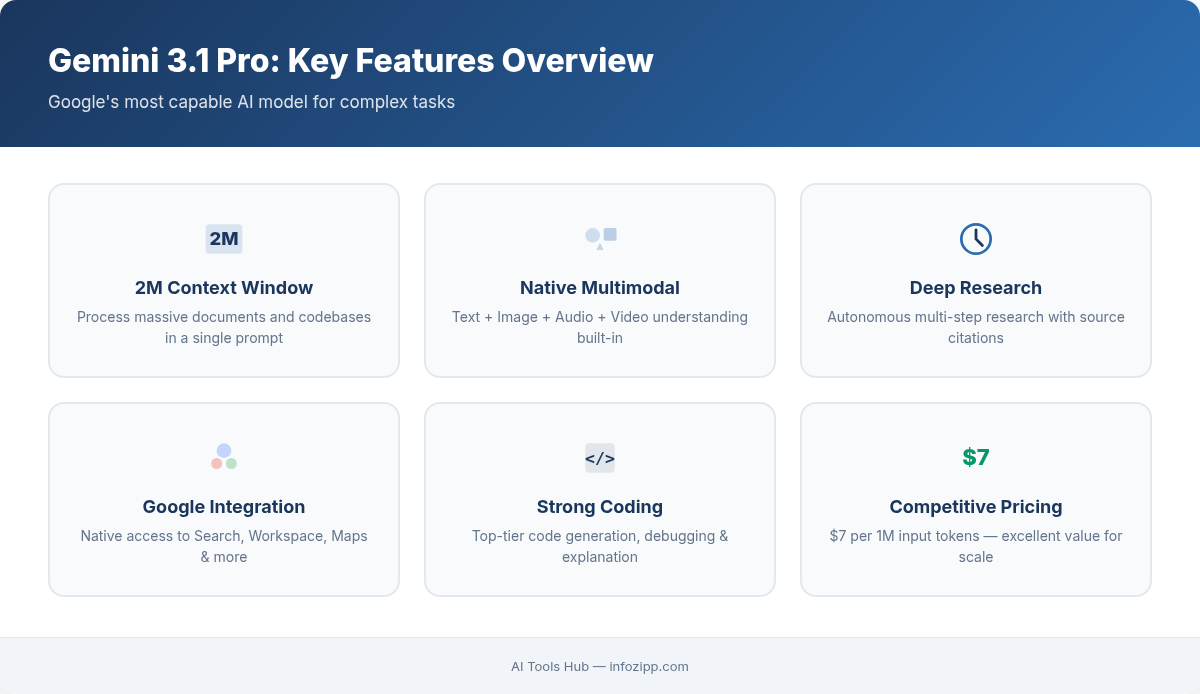
Google just dropped Gemini 3.1 Pro, and the AI landscape has shifted again. With a 77.1% score on the notoriously difficult ARC-AGI-2 benchmark, a 2-million-token context window, and seamless integration across the entire Google Workspace ecosystem, this is not just an incremental update — it is a statement of intent from a company that refuses to cede ground to OpenAI or Anthropic.
But benchmark scores and press releases only tell part of the story. After weeks of hands-on testing across research tasks, coding projects, document analysis, and creative work, here is what Gemini 3.1 Pro actually delivers — and where it still falls short.
What Is Gemini 3.1 Pro? The Big Picture
Gemini 3.1 Pro is Google DeepMind’s latest flagship large language model, released in March 2026 as a direct successor to Gemini 3 Pro. It sits at the top of Google’s AI model lineup, powering both the consumer-facing Gemini app and the enterprise-grade Vertex AI platform.
What makes this release particularly significant is the combination of three factors:
- Reasoning leap: The 77.1% ARC-AGI-2 score represents a massive jump in abstract reasoning capability, putting it in direct competition with GPT-5.4 and Claude 4.6 Opus for the most challenging cognitive tasks.
- Ecosystem integration: Unlike standalone AI chatbots, Gemini 3.1 Pro is woven directly into Google Docs, Sheets, Gmail, Meet, Drive, and the broader Workspace suite that over 3 billion people use daily.
- No price increase: Google kept pricing identical to Gemini 3 Pro, making this a pure upgrade for existing users and an aggressive play against competitors who have raised prices with their latest releases.
If you are new to the world of AI assistants and want to understand the broader landscape before diving in, our Beginner’s Guide to AI in 2026 is a solid starting point.
Benchmark Performance: What 77.1% on ARC-AGI-2 Actually Means
Let’s talk numbers, because the ARC-AGI-2 result is the headline that caught everyone’s attention.
ARC-AGI-2 (Abstraction and Reasoning Corpus for Artificial General Intelligence, version 2) is widely considered one of the most demanding tests for measuring genuine reasoning ability in AI systems. Unlike benchmarks that can be gamed through memorization or pattern matching on training data, ARC-AGI-2 presents novel visual puzzles that require true abstract reasoning — the kind of “figure it out from scratch” thinking that separates understanding from regurgitation.
Here is how the major models stack up:
| Model | ARC-AGI-2 Score | Release Date |
|---|---|---|
| Gemini 3.1 Pro | 77.1% | March 2026 |
| GPT-5.4 | 75.8% | February 2026 |
| Claude 4.6 Opus | 74.3% | January 2026 |
| Gemini 3 Pro | 68.2% | November 2025 |
| GPT-5 | 62.7% | August 2025 |
A 77.1% score is impressive, but context matters. The gap between these top-tier models is narrowing. In real-world usage, the difference between 77.1% and 74.3% rarely manifests as a noticeable quality gap for most tasks. Where it does matter is in edge cases: complex multi-step reasoning chains, novel problem types, and tasks that require genuine inference rather than pattern completion.
Beyond ARC-AGI-2, Gemini 3.1 Pro shows strong results across the board:
- MMLU-Pro: 91.4% (up from 88.7% on Gemini 3 Pro)
- HumanEval+ (coding): 93.2%
- MATH-500: 96.1%
- Multilingual understanding: Best-in-class across 40+ languages
The takeaway: Gemini 3.1 Pro is a legitimate top-tier reasoning model. It is not a runaway leader, but it has earned its seat at the table alongside GPT-5.4 and Claude 4.6 Opus.
The 2-Million-Token Context Window: A Genuine Game Changer
If there is one feature where Gemini 3.1 Pro pulls decisively ahead, it is context length. The 2-million-token context window — roughly equivalent to processing 1.5 million words or about 15 full-length novels in a single prompt — is the largest production-ready context window available from any major AI provider.
For comparison:
| Model | Max Context Window | Approximate Word Count |
|---|---|---|
| Gemini 3.1 Pro | 2,000,000 tokens | ~1,500,000 words |
| Claude 4.6 Opus | 1,000,000 tokens | ~750,000 words |
| GPT-5.4 | 256,000 tokens | ~192,000 words |
This is not just a specs-sheet number. In practical testing, the 2M context window transforms several workflows:
- Codebase analysis: You can feed an entire medium-sized codebase into a single prompt and ask Gemini to find bugs, suggest refactors, or explain architecture. No chunking, no summarization losses, no missed cross-file dependencies.
- Document review: Legal contracts, research paper collections, financial reports — Gemini can process hundreds of pages while maintaining coherent understanding of the whole.
- Meeting transcripts: Hours of meeting recordings can be transcribed and analyzed in one pass, with Gemini identifying action items, decisions, and contradictions across the entire conversation.
There is a caveat, though. While the context window accepts 2M tokens, response quality does degrade somewhat on information retrieval tasks when the relevant details are buried deep in very long contexts (the well-known “lost in the middle” problem). Google has improved this significantly compared to earlier Gemini versions, but it is still not perfect. For best results with extremely long inputs, placing the most critical information near the beginning or end of your prompt helps.
Multimodal Capabilities: Text, Image, Audio, Video, and Code
Gemini has been multimodal from the start, but version 3.1 Pro takes this further with notable improvements across every modality.
Text Generation and Analysis
The core text capabilities are excellent. Writing quality is natural and well-structured, with fewer of the “AI-ish” verbal tics that plagued earlier models. Gemini 3.1 Pro handles nuance, tone shifts, and complex instructions with noticeably more finesse than its predecessor. It is particularly strong at summarization — condensing lengthy documents while preserving key details and nuance.
Image Understanding and Generation
Image analysis has taken a significant step forward. Gemini 3.1 Pro can now reliably read handwritten notes, interpret complex charts and diagrams, extract data from screenshots, and analyze photographs with impressive detail. The model can also generate images natively through its Imagen 4 integration, though dedicated image tools like Midjourney still produce more polished artistic results.
Audio Processing
Native audio understanding means you can upload audio files directly and ask Gemini to transcribe, summarize, translate, or analyze them. This works surprisingly well with meeting recordings, podcast episodes, and lectures. Background noise handling has improved, and speaker diarization (identifying who said what) is more reliable.
Video Analysis
This is where Google’s unique advantage becomes clear. Gemini 3.1 Pro can process video files directly, understanding both visual content and audio. You can upload a conference talk and get a detailed summary, ask questions about specific moments, or extract all the key data points presented in slides. The combination of the 2M context window and video understanding means you can analyze hours of video content in a single session.
Code Generation and Debugging
Coding capabilities are strong and competitive with GPT-5.4 and Claude 4.6 Opus. Gemini 3.1 Pro handles Python, JavaScript, TypeScript, Go, Rust, and most major languages with high accuracy. Its integration with Google’s code toolchain (Colab, IDX, Cloud) gives it practical advantages for developers already in the Google ecosystem.
Google Workspace Integration: The Killer Feature
Here is where Gemini 3.1 Pro genuinely separates itself from the competition. While GPT-5.4 and Claude 4.6 Opus are excellent standalone AI assistants, Gemini is embedded directly into the tools that billions of people use for work every day.
Gemini in Google Docs
The Docs integration goes far beyond simple text generation. Gemini 3.1 Pro can now rewrite entire documents while preserving formatting, generate content that matches your existing writing style by analyzing your previous documents in Drive, and create complex structured documents (proposals, reports, briefs) from rough notes or bullet points. The “Help me write” sidebar is genuinely useful rather than gimmicky.
Gemini in Google Sheets
This is arguably the most impactful integration. Gemini 3.1 Pro can analyze spreadsheet data and generate insights, create complex formulas from natural language descriptions, build charts and pivot tables automatically, and identify patterns or anomalies in datasets. For anyone who has struggled with VLOOKUP or pivot tables, having an AI assistant that understands your actual data in context is transformative. For more on AI-powered data analysis, see our guide on using Claude for data analysis, which covers complementary approaches.
Gemini in Gmail
Email management gets a major upgrade. Gemini can summarize long email threads, draft contextually appropriate replies, extract action items from conversations, and even flag emails that might need urgent attention based on content analysis. The threading context — understanding the full history of a conversation — is where the large context window pays dividends.
Gemini in Google Meet
Real-time meeting assistance includes live transcription, automated note-taking, action item extraction, and post-meeting summaries. The most useful feature is the ability to ask Gemini questions during a meeting about what was discussed earlier — particularly helpful in long strategy sessions.
The bottom line on Workspace integration: if your organization runs on Google Workspace, Gemini 3.1 Pro is not just another AI tool to learn — it is an upgrade to tools you already know. That frictionless adoption path is Google’s most powerful competitive advantage.
Gemini 3.1 Pro vs GPT-5.4 vs Claude 4.6 Opus: Quick Comparison
Rather than doing a deep comparison here (we have a comprehensive ChatGPT vs Claude vs Gemini comparison for that), here is a quick overview of where each model excels:
| Category | Gemini 3.1 Pro | GPT-5.4 | Claude 4.6 Opus |
|---|---|---|---|
| Reasoning (ARC-AGI-2) | 77.1% | 75.8% | 74.3% |
| Context Window | 2M tokens | 256K tokens | 1M tokens |
| Ecosystem | Google Workspace | Microsoft 365 / Plugins | Standalone / API |
| Multimodal | Text, Image, Audio, Video | Text, Image, Audio | Text, Image |
| Best For | Workspace users, multimodal tasks | General-purpose, creative writing | Coding, analysis, long documents |
| Pricing (Pro tier) | $20/month | $20/month | $20/month |
The honest truth: all three models are remarkably capable, and for 80% of tasks, you would get excellent results from any of them. The differentiator is ecosystem fit and specific workflow needs, not raw intelligence. Check out our list of best ChatGPT alternatives if you want to explore even more options.
Pricing and Availability
Google’s pricing strategy with Gemini 3.1 Pro is aggressive and straightforward:
- Free tier: Access to Gemini 3.1 Pro with rate limits through the Gemini app (gemini.google.com). Generous for casual use.
- Google One AI Premium ($19.99/month): Full access to Gemini 3.1 Pro with higher rate limits, plus 2TB of Google storage, and Gemini integration across all Workspace apps. This is the sweet spot for most individual users.
- Google Workspace add-on ($20/user/month for businesses): Enterprise-grade Gemini access with admin controls, data governance, and no data used for training.
- API pricing (Vertex AI): $1.25 per million input tokens, $5.00 per million output tokens. Competitive with OpenAI and Anthropic’s API pricing.
The fact that Google One AI Premium bundles 2TB of storage with full Gemini Pro access makes it arguably the best value proposition in the AI assistant market. You are paying roughly the same as ChatGPT Plus or Claude Pro but getting cloud storage on top.
Who Should Use Gemini 3.1 Pro? (And Who Shouldn’t)
After extensive testing, here is our breakdown:
Gemini 3.1 Pro Is Ideal For:
- Google Workspace power users: If your workflow revolves around Docs, Sheets, Gmail, and Drive, Gemini 3.1 Pro is the obvious choice. The integration is seamless and genuinely useful.
- Researchers and analysts working with long documents: The 2M context window is unmatched. If you regularly work with massive datasets, lengthy reports, or extensive codebases, this context length is a real advantage.
- Multimodal workflows: If your work involves processing video, audio, and images alongside text, Gemini’s native multimodal capabilities are the most comprehensive available.
- Teams and organizations already on Google Cloud: The enterprise integration, data governance, and admin controls make it a natural fit.
- Budget-conscious users: The free tier is generous, and the paid tier bundles significant value beyond just AI access.
You Might Prefer Alternatives If:
- You need the best coding assistant: Claude 4.6 Opus still edges ahead for complex software development tasks, particularly in understanding large codebases and generating production-quality code.
- You prioritize creative writing: GPT-5.4 tends to produce more varied and stylistically nuanced creative content.
- You are in the Microsoft ecosystem: GPT-5.4’s integration with Microsoft 365 through Copilot mirrors what Gemini does with Google Workspace.
- Privacy is your top concern: While Google’s enterprise tier has strong data policies, some users may prefer Anthropic’s approach to data handling. Our guide on AI privacy and security covers this in detail.
AI Tools Hub Verdict
Gemini 3.1 Pro is the most well-rounded AI model Google has ever shipped. The 77.1% ARC-AGI-2 score puts it at the top of the reasoning leaderboard (for now), the 2-million-token context window is a genuine differentiator, and the Workspace integration transforms it from “another AI chatbot” into an embedded productivity layer across the tools billions already use.
Is it definitively better than GPT-5.4 or Claude 4.6 Opus? No — and anyone claiming otherwise is oversimplifying. The frontier AI models have converged to a point where the differences are more about ecosystem fit and specific use-case strengths than raw capability gaps.
But here is what Google got right: they met the competition on quality and then won on distribution. By keeping the price flat, bundling storage, and embedding Gemini directly into Workspace, they have made the adoption decision trivially easy for anyone already in the Google ecosystem.
Our recommendation: If you use Google Workspace daily, upgrading to Gemini 3.1 Pro through Google One AI Premium is a no-brainer at $19.99/month. If you are ecosystem-agnostic and choosing purely on AI capability, try the free tiers of Gemini, ChatGPT, and Claude — then decide based on which one fits your specific workflow best.
Rating: 4.5 out of 5 — A top-tier AI model with the strongest ecosystem integration story in the market. The only thing holding it back from a perfect score is that its raw reasoning advantage over GPT-5.4 and Claude 4.6 Opus is slim, and creative writing remains a relative weak point.

Alex Kim is an AI tools reviewer and tech writer with over 5 years of experience evaluating SaaS and AI products. He specializes in hands-on comparisons of AI writing assistants, coding tools, and productivity software — testing each tool through real-world workflows before publishing any recommendation. His mission at AI Tools Hub is to help readers cut through the hype and find AI tools that actually deliver results.