You need an answer. A real, reliable, well-sourced answer. Do you type your question into Perplexity AI and get a citation-backed response in seconds? Or do you ask ChatGPT and get a detailed, conversational explanation you can drill into with follow-ups?
This is the question millions of people face every day in 2026, and the answer is less obvious than you might think. Both tools have evolved dramatically — Perplexity has become a genuine search engine replacement for many users, while ChatGPT now processes over 1 billion queries per day and drives 77% of all AI-driven referral traffic to websites.
We spent weeks testing both platforms head-to-head across real-world scenarios: academic research, market analysis, fact-checking, everyday questions, and creative projects. Here is what we found.
Perplexity AI vs ChatGPT: The Fundamental Difference
Before diving into feature comparisons, it is important to understand that Perplexity AI and ChatGPT are built on fundamentally different philosophies — even though their capabilities increasingly overlap.
Perplexity AI is an AI-native search engine. Its primary mission is to find, synthesize, and cite information from across the web. Every response is designed to answer your question with traceable sources. Think of it as what Google Search would look like if it were rebuilt from scratch with AI at its core.
ChatGPT is a conversational AI assistant that also happens to be able to search the web. Its primary strength is understanding context, maintaining complex conversations, and performing a wide range of tasks — from writing code to analyzing data to generating creative content. Web search is one capability among many.
This distinction matters because it shapes how each tool approaches the same question. Ask both “What are the latest developments in nuclear fusion?” and you will get two very different experiences:
- Perplexity will search the web in real time, compile information from multiple recent sources, and present a structured answer with numbered citations you can click to verify.
- ChatGPT will give you a comprehensive, well-organized explanation that draws on its training data and (if web browsing is enabled) recent web results, presented in a conversational format optimized for understanding.
Neither approach is inherently better — they serve different needs. The question is which approach serves your needs better. If you are still figuring out which AI tools fit your workflow, our Beginner’s Guide to AI in 2026 can help you build a solid foundation.
Feature-by-Feature Comparison
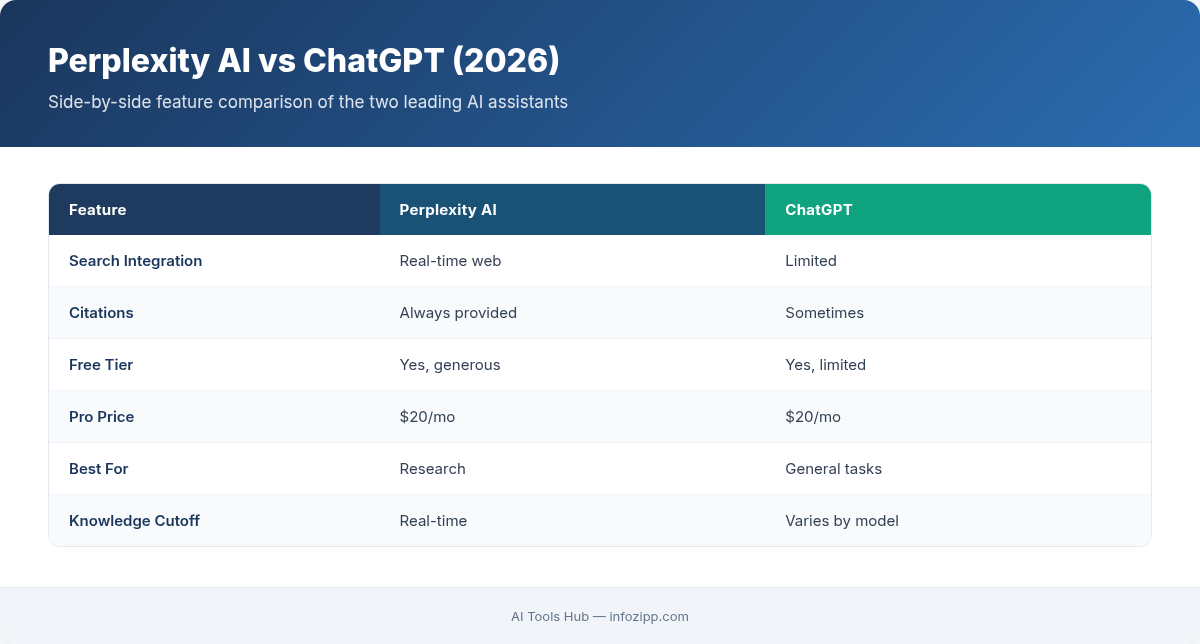
Let’s break down what each platform offers in 2026:
| Feature | Perplexity AI | ChatGPT |
|---|---|---|
| Core Function | AI search engine | Conversational AI assistant |
| Real-Time Web Access | Always on, every query | Available (browsing mode) |
| Source Citations | Inline numbered citations on every response | Occasional links, not systematic |
| Pro Search / Deep Research | Yes — multi-step research with follow-up questions | Deep Research mode available |
| File Upload & Analysis | PDFs, documents, images | PDFs, documents, images, spreadsheets, code |
| Code Generation | Basic code assistance | Advanced — full IDE-like capabilities |
| Image Generation | Yes (via DALL-E integration) | Yes (native DALL-E, GPT-created images) |
| Plugins / GPTs | Limited integrations | Extensive GPT Store, plugins, custom GPTs |
| Advanced Data Analysis | Limited | Yes — Code Interpreter, chart generation |
| Conversation Memory | Session-based | Persistent memory across conversations |
| Mobile App | iOS, Android | iOS, Android |
| API Access | Yes | Yes |
| Free Tier | Generous — unlimited basic searches | Available with GPT-4o access |
| Paid Plan | Perplexity Pro: $20/month | ChatGPT Plus: $20/month, Pro: $200/month |
Head-to-Head Testing: Real-World Scenarios
Benchmark tables are useful, but real-world performance is what matters. We tested both platforms across four common use cases that represent how most people actually use AI search and assistant tools.
Test 1: Academic Research
Query: “What is the current evidence on intermittent fasting for longevity in humans, and what do the most recent clinical trials show?”
Perplexity’s response: Outstanding. Perplexity searched across PubMed, medical journals, and recent news articles, then synthesized a comprehensive answer with 12 inline citations. Each claim was linked to a specific study or review article. The Deep Research mode went further, asking clarifying questions about which aspects of longevity we were most interested in, then producing a multi-page report with organized sections covering caloric restriction mimicry, autophagy mechanisms, and recent 2025-2026 clinical trial results.
ChatGPT’s response: Very good but different. ChatGPT provided a thorough, well-organized overview of the intermittent fasting research landscape. The explanation was clearer and more accessible for non-experts, with better context about why certain findings matter. However, source citations were sparse — it mentioned study names and authors but did not consistently link to specific papers. When pushed for sources, it provided them, but the verification burden fell on the user.
Verdict: Perplexity wins for academic research. When you need verifiable, citation-backed information from specific sources, Perplexity’s approach is purpose-built for this task. For a deeper look at how Perplexity handles research workflows, see our guide to using Perplexity for research.
Test 2: Market Research
Query: “What is the current market size of the AI coding assistant industry, who are the major players, and what are the growth projections for 2027?”
Perplexity’s response: Strong. It pulled data from market research summaries, industry reports, and recent news articles. We got specific numbers (market size estimates, growth rates, funding amounts) with sources. The information was current and well-organized.
ChatGPT’s response: Equally strong but with a different flavor. ChatGPT provided a more narrative-driven analysis that connected the dots between data points. It offered strategic insights — why certain trends were emerging, what they meant for different stakeholders — that went beyond simple data compilation. When asked to create a comparison chart, it generated a clean, well-structured table immediately.
Verdict: Tie, with different strengths. Perplexity excels at gathering and citing specific data points. ChatGPT excels at synthesizing that data into actionable analysis. The ideal workflow might be to use Perplexity to gather verified data, then ChatGPT to analyze it.
Test 3: Fact-Checking
Query: “Did the EU actually ban AI-generated content in political advertising in 2025?”
Perplexity’s response: Precise and nuanced. It found the specific EU regulation, clarified what it actually says versus common misinterpretations, cited the official EU documents, and included recent reporting on enforcement. The answer distinguished between what was proposed, what was passed, and what is actually being enforced — a critical distinction that many sources get wrong.
ChatGPT’s response: Accurate in its general answer but less precise on the details. It correctly identified the regulation and its main provisions but was less thorough in distinguishing between the proposal and final text. When asked follow-up questions, it refined its answer, but the initial response lacked the specificity that Perplexity provided upfront.
Verdict: Perplexity wins for fact-checking. When accuracy and source verification are the priority, Perplexity’s citation-first approach provides higher confidence in the answer.
Test 4: Daily Questions and General Knowledge
Query: “What is the best way to clean a cast iron skillet, and does soap really ruin the seasoning?”
Perplexity’s response: Good, practical answer with citations from cooking websites and manufacturer recommendations. Straightforward and to the point.
ChatGPT’s response: Excellent. ChatGPT provided a warm, conversational explanation that debunked the soap myth, explained the chemistry behind seasoning (polymerized oils), gave step-by-step cleaning instructions, and even anticipated follow-up questions about re-seasoning and maintenance. It felt like getting advice from a knowledgeable friend rather than reading a search result.
Verdict: ChatGPT wins for everyday questions. For general knowledge queries where you want understanding rather than source verification, ChatGPT’s conversational depth is more satisfying and useful.
The Citation Question: Why It Matters More Than You Think
One of the most significant differences between Perplexity and ChatGPT comes down to how they handle sources, and this deserves its own section because it affects trustworthiness in important ways.
Perplexity’s approach: Every response includes numbered inline citations. When Perplexity says “Global AI spending reached $240 billion in 2025 [1][2],” you can click those numbers and see exactly where the claim came from. This is not optional or inconsistent — it is the fundamental architecture of the product.
ChatGPT’s approach: Citations are available but not systematic. ChatGPT may mention sources by name, provide links when using browsing mode, or reference specific studies. But the default behavior is to present information as authoritative text without consistent source attribution. You can ask “where did you get that?” and usually get a reasonable answer, but the verification burden is on you.
Why does this matter? In an era of AI hallucination, misinformation, and generated content, the ability to quickly verify claims is not a nice-to-have — it is essential. Perplexity’s citation approach means you can trust-but-verify in seconds. ChatGPT’s approach requires more effort to validate.
That said, citations do not equal accuracy. Perplexity can (and occasionally does) cite sources that do not support the claim being made, or cite low-quality sources alongside authoritative ones. Citations reduce the verification burden but do not eliminate it. We explored this topic more in our Perplexity vs Google vs ChatGPT comparison.
Pricing Breakdown: Free vs Paid
Both platforms offer free tiers, but the paid experiences are where the real power lies. Here is how the pricing compares:
| Plan | Perplexity AI | ChatGPT |
|---|---|---|
| Free | Unlimited basic searches, limited Pro Search (5/day), basic model | Access to GPT-4o, limited usage, basic features |
| Pro / Plus ($20/month) | Unlimited Pro Search, Deep Research, file uploads, multiple AI models (GPT-5.4, Claude, Gemini), API credits | GPT-5.4 access, higher limits, Advanced Data Analysis, image generation, custom GPTs, memory |
| Enterprise / Pro ($200/month) | Enterprise: custom pricing, team features, admin controls | Pro: Unlimited GPT-5.4, highest priority, advanced voice, extended thinking |
A notable advantage of Perplexity Pro: you get access to multiple AI models, not just one. This means you can use GPT-5.4, Claude 4.6, or Gemini 3.1 through the same interface, choosing the best model for each task. ChatGPT, naturally, only gives you access to OpenAI’s models.
For most users, both platforms at $20/month represent excellent value. The question is not whether the paid tier is worth it (it is, for both), but which platform’s paid features align better with your needs.
Strengths and Weaknesses Summary
Perplexity AI Strengths
- Citation-first approach: Every claim is sourced, making verification fast and natural.
- Deep Research mode: Multi-step research that asks clarifying questions and produces comprehensive reports.
- Real-time information: Always searching the live web, never relying solely on training data.
- Multi-model access: Pro subscribers can use GPT-5.4, Claude, and Gemini through one interface.
- Clean, focused interface: Designed for information retrieval without distractions.
Perplexity AI Weaknesses
- Limited creative capabilities: Not designed for long-form writing, brainstorming, or creative projects.
- Shallow conversation depth: Follow-up conversations are functional but lack the nuance of ChatGPT’s contextual understanding.
- Smaller ecosystem: No equivalent to GPTs, plugins, or the extensive third-party integration library.
- Occasional citation quality issues: Sources cited do not always fully support the claims made.
ChatGPT Strengths
- Conversational depth: Unmatched ability to maintain context, handle nuance, and go deep on topics through multi-turn dialogue.
- Versatility: Coding, writing, analysis, image generation, data processing — one tool does it all.
- Custom GPTs and plugins: Massive ecosystem of specialized tools and integrations.
- Advanced Data Analysis: Code Interpreter can process files, generate charts, and run calculations.
- Memory and personalization: Learns your preferences over time for better responses.
- Scale and community: With over 1 billion daily queries, the user community, shared GPTs, and prompt libraries are unmatched.
ChatGPT Weaknesses
- Inconsistent citations: Source attribution is not systematic, making verification harder.
- Hallucination risk: Despite improvements, ChatGPT can still present fabricated information confidently.
- Information freshness: While browsing mode helps, ChatGPT sometimes defaults to training data when live search would be more appropriate.
- Feature overload: The sheer number of capabilities can be overwhelming for users who just want quick answers.
When to Use Which: Practical Decision Guide
Rather than declaring one tool “better” than the other, here is a practical guide based on what you are actually trying to do:
Use Perplexity AI when you need to:
- Research a topic and need verifiable sources
- Fact-check a specific claim quickly
- Get the most up-to-date information on a fast-moving story
- Compile data from multiple sources into a single answer
- Produce a research report with proper citations
- Compare information across different sources to find consensus
Use ChatGPT when you need to:
- Work through a complex problem with back-and-forth conversation
- Write, edit, or refine content (articles, emails, documentation)
- Generate or debug code
- Analyze data, spreadsheets, or files
- Brainstorm ideas or explore creative concepts
- Build custom workflows with GPTs or plugins
- Get a thorough explanation of a concept you are learning
Use both together when you need to:
- Research a topic thoroughly (Perplexity for sourced data) and then synthesize it into a deliverable (ChatGPT for writing and analysis)
- Verify ChatGPT’s claims by cross-referencing with Perplexity’s cited sources
- Get multiple perspectives on a complex question
Many AI power users at AI Tools Hub and elsewhere have settled on exactly this dual-tool approach. Perplexity is the research engine; ChatGPT is the thinking and creation engine. Together, they cover nearly every information need. For another powerful research tool worth adding to your stack, check out our guide on Google NotebookLM for research.
AI Tools Hub Verdict
Perplexity AI and ChatGPT are not really competitors — they are complementary tools that happen to overlap in certain areas. Declaring a single “winner” misses the point.
Choose Perplexity AI if your primary need is information retrieval with verifiable sources. If you are a researcher, journalist, student, analyst, or anyone whose work depends on finding accurate, well-sourced information quickly, Perplexity is purpose-built for you. Its citation-first approach is not just a feature — it is a fundamentally different (and often better) way to interact with AI for research tasks.
Choose ChatGPT if you need a versatile AI assistant that can handle a wide range of tasks beyond search. If you write, code, analyze data, create content, or need a thinking partner for complex problems, ChatGPT’s depth of capability and conversational intelligence remain unmatched. The plugin ecosystem and custom GPTs add a layer of extensibility that no other platform can match.
Choose both if you are serious about maximizing your productivity with AI. The $40/month combined cost of Perplexity Pro and ChatGPT Plus is a bargain for the capabilities you get, and the two tools complement each other remarkably well.
Our bottom line: Start with whichever tool matches your most common use case. If you find yourself constantly asking ChatGPT “where did you get that?” or wishing Perplexity could help you write and create, that is your signal to add the other tool. Most power users end up using both — and that is not a bug, it is the smartest approach to AI tools in 2026.

Alex Kim is an AI tools reviewer and tech writer with over 5 years of experience evaluating SaaS and AI products. He specializes in hands-on comparisons of AI writing assistants, coding tools, and productivity software — testing each tool through real-world workflows before publishing any recommendation. His mission at AI Tools Hub is to help readers cut through the hype and find AI tools that actually deliver results.